Airboats
Five Days at MemorialAirboats were the improvised vehicles that connected flooded Memorial Medical Center with dry ground during the hospital’s evacuation. Their ability to launch from shallow water made rescue possible where ordinary road transport could not reach; their limited capacity, slow trips, and dependence on ambulance handoffs also exposed how little coordination surrounded the effort. They offered a route out, but not a complete evacuation system.
Arrival at Memorial
By Wednesday morning, workers had moved many LifeCare patients into wheelchairs and toward the stairwells, expecting boats to carry them to dry ground. The plan was to gather them on the ambulance ramp outside the emergency room. At about nine thirty, after a sleepless night, Gina Isbell returned to the floor to oversee their care. The anticipated arrival of boats became a visible sign that help might reach the hospital: when two flat-bottomed airboats approached, people inside Memorial watched from the windows and responded with cheers and calls of relief.
Sandra LeBlanc was aboard one of the boats. A paramedic and coordinator of the Emergency Medical Technology program at Elaine P. Nunez Community College in nearby Chalmette, she had set out with her husband, Mark, to reach his mother, Vera LeBlanc, a LifeCare patient. After learning that New Orleans had flooded, they left relatives’ home in northern Louisiana, traveled to Baton Rouge to register as volunteers, and sought a way into the city. At the registration site, officials directed them toward a triage center on a freeway interchange. There, they learned Memorial and Baptist were being prioritized last among hospitals, though the reason was unknown.
The LeBlancs already knew Memorial’s location and history: Mark had been born there when it was known as Baptist, and his family had long received care there. Two airboat pilots asked if the couple could guide them to the hospital. The LeBlancs agreed. The boats could launch without much water, and after exploring a possible route by truck, the group found water on Jefferson Highway, just east of Ochsner Medical Center and near the Orleans Parish line. From there, the route followed the highway toward Memorial and became Claiborne Avenue—the way back into the city that the LeBlancs had used to evacuate days earlier.
A route made by volunteers
The airboats’ large rear fans propelled them over the flooded highway. As they traveled farther into New Orleans, they encountered people in the water who turned toward the passing boats. The LeBlancs could offer directions toward dry land, but the boats were bound for the hospital. Two small aluminum boats joined the group on the way. At Memorial, Mark borrowed a flashlight from a nurse and climbed seven flights to LifeCare, where he found his mother. He and Sandra then went to Diane Robichaux, the visibly pregnant senior leader on the floor, to explain that they had brought boats and would try to bring more.
The rescue depended on a second journey by road as well as the boats’ passage through the flood. Sandra told Robichaux that ambulances would be needed where patients were dropped off. Robichaux no longer had a way to contact her corporate office to request them, so the LeBlancs offered to use their working cell phone to help arrange transport. This gap mattered: the boats could move people out of the immediate flood zone, but patients still needed a connection from the landing place to onward transport.
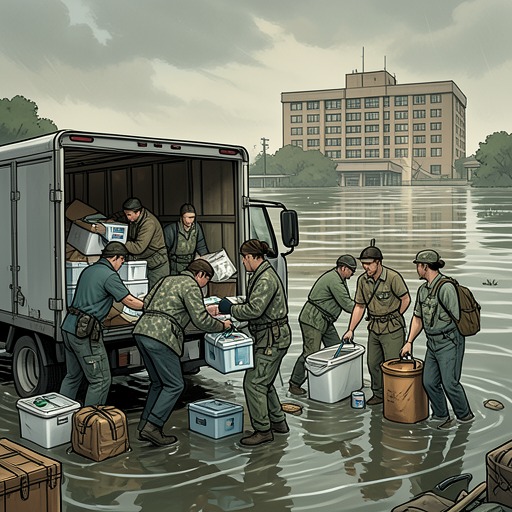
At first, roughly three dozen patients classed as category 1 from Memorial and LifeCare were directed to the emergency-room ramp, where Gina Isbell and Memorial nurse manager Karen Wynn oversaw their care. The plan was for these patients to leave by airboat. The first evacuees were transferred at a drop site into waiting ambulances, after which the pilots began the more-than-three-mile return to Memorial. Moving carefully to avoid debris, each round trip took over an hour. The boats were therefore useful but not rapid shuttles: every run consumed time, and each patient’s departure depended on the receiving transport being in place.
Changing landing sites and priorities
Sandra LeBlanc searched for a closer dry drop point near a Rite Aid and a Copeland’s Restaurant, nine blocks south of Memorial. The area along the city’s southwest border known as the sliver by the river was dry and connected to roads leading out of town. The pilots, soon joined by a much larger vessel, began carrying people toward it. But no ambulances were waiting at the new site, and people had to cross dirty, shallow water on foot to reach dry ground. Changing the destination shortened the boat journey’s geographic reach without solving the handoff problem.
The evacuation strategy shifted as these practical limits met the hospital’s priorities. Rather than continuing to load the sickest patients onto the boats, staff began sending out the relatively small number considered well enough for discharge. Several doctors took charge of loading from the open-air emergency-room ramp, and hospital employees and patients’ family members were also allowed to leave. The line extended from the ramp through the emergency room into reception. The boats were thus no longer serving only as a means of carrying patients to ambulances; they had become the threshold for a broader, uneven departure from the hospital.
The uncertainty continued at the water’s edge. Karen Wynn could not tell people where the boats would take them, and some hesitated as they approached the chance to leave. One woman refused to board without her purse, despite Wynn offering to take responsibility for it. The episode showed that a boat’s arrival did not by itself make evacuation straightforward: people still faced decisions about what they could bring and what they were willing to leave behind. For others, the unknown destination made the familiar hospital seem easier to remain in.
Rescue, limits, and the final crossings
By later in the evacuation, the airboats’ own constraints had become pressing. Mark and Sandra learned that fuel was running low and that the pilots had heard reports of people shooting at rescuers. The volunteers from the Louisiana swamplands did not intend to return with their vessels on Thursday, although hundreds of people remained at Memorial. With no assurance that more helicopters would arrive that day, the LeBlancs decided that Vera should leave by airboat rather than spend another night at the hospital.
They tried to carry her cot down to the first floor, but it bent under the load. Several doctors objected to taking her. The LeBlancs continued, with two volunteers helping them carry the cot to the emergency-room ramp, where a pane of Plexiglas had been removed to let people board. Vera was placed on an airboat and fitted with earmuffs. Before leaving, Sandra also guided a hospital security guard onto the boat; he had worked with her on the ramp and was desperate to get out. The boats had begun as an expected means of moving patients to safety, but by this point they were also the route the LeBlancs used to take responsibility for particular people when larger rescue arrangements remained uncertain.
Their work did not empty the hospital. As able-bodied people departed, about two dozen category 1 patients remained in wheelchairs on the emergency-room ramp, waiting for their turn. That image defines the airboats’ double role in the episode: they made rescue tangible, crossing flooded streets that blocked ordinary vehicles, while the slow return trips, changing drop sites, absent ambulances, fuel shortage, and finite number of runs kept rescue partial. They were indispensable, but they could not substitute for an organized chain of evacuation from hospital bed to dry ground and onward transport.